
 Language


More Language
Language
With the continuous development of the modern construction industry and steel structure engineering, steel is increasingly being used in the construction of factory buildings, storage facilities, commercial structures, and industrial equipment. Compared to traditional concrete structures, steel structures offer advantages such as rapid construction, relatively lower component weight, flexible processing, and ease of assembly. Among various steel structural materials, C shaped steel—characterized by its efficient cross-sectional shape, ease of processing, light weight, and broad range of applications—has become a common structural steel material in construction projects.
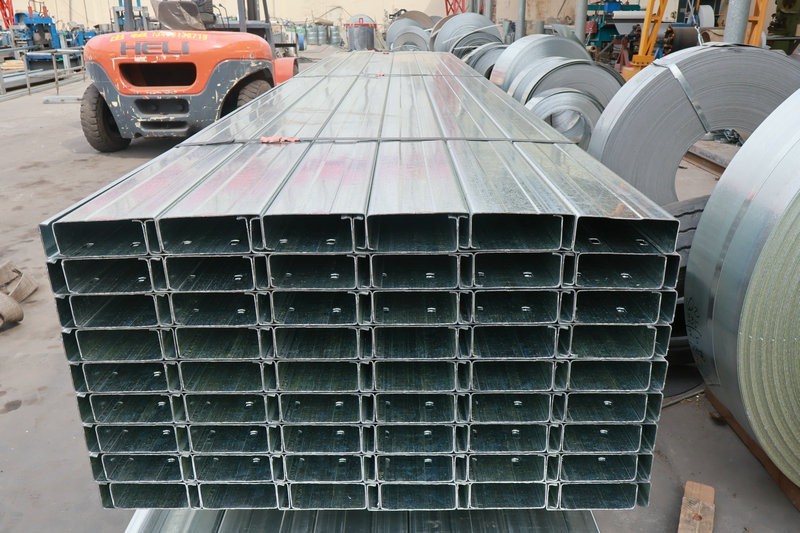
C shaped steel is a type of cold-formed, thin-walled structural steel with a cross-section shaped like the letter "C." It is typically manufactured from steel strips or plates through a continuous roll-forming process. Its cross-section generally consists of a web, an upper flange, and a lower flange; some versions also feature "lips" (curled edges) to enhance cross-sectional performance and stability. The production process for C shaped steel typically involves uncoiling, leveling, punching, roll-forming, and cutting to specific lengths. By adjusting the forming parameters of the roll-forming equipment, it is possible to produce C shaped steel in various widths, heights, thicknesses, and lengths.
Depending on production processes and specific application requirements, C shaped steel can be made from different types of steel, such as standard structural steel or steel grades specifically designed for cold-forming. Some products are also galvanized to improve corrosion resistance in appropriate environments.
Compared to certain hot-rolled steel sections, C shaped steel utilizes a thin-walled design. This allows for a reduction in material usage and lower self-weight of the components, while still meeting specific structural requirements.
C shaped steel can be produced continuously via roll-forming equipment and can be cut, punched, and fabricated for connections according to project specifications, making it well-suited for standardization and mass production.
C shaped steel can be connected to other steel structural components using bolts, specialized connectors, or other engineered methods, facilitating transport, assembly, and on-site construction.
For various projects, C shaped steel can be selected with specific web heights, flange widths, lip (stiffener) dimensions, and material thicknesses to suit different structural requirements.
It should be noted that C shaped steel is an open, thin-walled profile; its structural behavior differs from that of common hot-rolled sections like I-beams or H-beams. In particular, when subjected to bending moments, the section may be susceptible to local buckling, overall instability, or torsion. Therefore, the load-bearing capacity of C shaped steel cannot be determined solely by its external dimensions.
C shaped steel can indeed function as a beam. In light-gauge steel construction, it is frequently used for roof purlins, secondary beams, floor joists, and other lightweight load-bearing components.
A beam is a structural member designed primarily to resist transverse loads. When loads from roof panels, floor slabs, or other building elements are applied to a beam, the beam utilizes its inherent flexural (bending) and shear resistance to transfer these loads to columns, walls, or other supporting structures. Since C shaped steel possesses a certain degree of flexural capacity, it can serve this purpose, provided it meets the specific structural design requirements. For instance, in light-industrial buildings, C shaped steel is commonly used as roof purlins, supporting roof panels and transferring roof loads to the primary structural framework.
In some light-gauge structures, specially designed C shaped steel can also serve as secondary beams or other types of beam members. However, whether it can function as a primary load-bearing beam must be determined through calculations based on the specific structural conditions.
- Span: A longer span generally results in higher bending moments and stricter requirements for deflection control.
- Loads: Factors such as the weight of roof panels, floor slabs, and equipment, as well as occupancy (live loads) and environmental forces (wind, snow, etc.), all influence the forces acting on the beam.
- Cross-Sectional Dimensions: The web height, flange width, lip dimensions, and material thickness directly influence the performance characteristics of the section. - Steel Strength: Different steel grades possess varying levels of strength and mechanical properties.
- Support Conditions: The end connections of a beam, its lateral bracing, and the overall structural configuration all influence its stability.
- Deflection Requirements: Even if a beam meets strength requirements, excessive deflection can still impair the intended functionality of a roof or floor.
Therefore, it is not that C shaped steel cannot be used as a beam; rather, its suitability must be determined based on specific project conditions.
Roof purlins represent one of the most common applications for C shaped steel. Typically arranged along the roof, purlins support the roof cladding and transfer roof loads to the roof trusses or primary beams. In light-gauge steel structures—such as industrial workshops, warehouses, and agricultural buildings—C shaped steel can be selected based on the roof span and load requirements. Its cross-sectional shape is well-suited to the needs of many lightweight roof systems. Roof purlins must support not only the self-weight of the roof cladding but also wind loads, snow loads, maintenance loads, and other potential forces. For roofs with larger spans or higher load requirements, the appropriate cross-section and support configuration must be determined through engineering design.
In certain lightweight structures, C shaped steel can serve as secondary beams. These beams are typically connected between primary beams or other main load-bearing components; they support a portion of the floor or roof load and transfer it to the primary structure. For instance, in lightweight platforms, equipment support structures, and small-scale steel buildings, properly engineered C shaped steel can function as a secondary beam. It should be noted, however, that floor-level secondary beams must account for occupancy, furniture, equipment, and other operational loads—meaning their design requirements may be more stringent than those for standard roof purlins. For floor structures, in addition to strength, factors such as vibration, deflection, and the reliability of connections must be carefully considered.
C shaped steel is also frequently used in building wall systems, serving as girts to support wall cladding or enclosure panels. Wall girts primarily support the self-weight of wall cladding and wind loads, transferring these forces to steel columns or other supporting members. In light-industrial facilities, warehouses, and commercial buildings, C shaped steel girts are well-suited for many common envelope systems. Although wall girts typically do not carry vertical loads—such as those from floor slabs or roofs—they must still be designed to withstand wind pressure and suction, while also accounting for connection integrity and overall structural stability.
In certain industrial facilities, C shaped steel can be utilized for light-duty platforms, auxiliary equipment supports, and other structural components. For instance, support frames for relatively lightweight equipment—where loading conditions are clearly defined—may incorporate C shaped steel as horizontal members or secondary load-bearing elements. However, because equipment operation can generate vibrations, impacts, or concentrated loads, these components cannot be selected based solely on criteria for standard static beams. Instead, specific calculations must be performed, taking into account the equipment's weight, operational state, and the configuration of the support structure.
As a cold-formed, thin-walled section, C shaped steel offers flexibility; its cross-sectional dimensions and plate thickness can be adjusted to meet the design requirements of various lightweight structures. With proper design, it is possible to achieve significant load-bearing capacity using a minimal amount of material, which helps control both the structure's self-weight and material costs. It should be noted, however, that high material efficiency does not imply that plate thickness can be reduced indefinitely; thinner sections are generally more susceptible to issues such as local buckling, connection challenges, and the need for higher precision during fabrication.
C shaped steel is typically manufactured via continuous roll-forming lines, making it ideal for standardized, high-volume production. Modern roll-forming equipment can integrate multiple processes—including uncoiling, leveling, punching, roll-forming, and cutting to length—into a single, streamlined operation. By adjusting equipment parameters, manufacturers can produce steel sections in a wide variety of specifications. For building material manufacturers, continuous roll-forming enhances production efficiency and reduces the need for manual labor.
Due to their relatively light weight, C shaped steel members reduce the burden of transportation and on-site handling while still meeting structural requirements. Furthermore, C shaped steel can be cut to specific lengths and prefabricated according to engineering drawings, which helps improve on-site installation efficiency.
C shaped steel is available in a wide range of specifications; dimensions such as section height, flange width, lip (stiffener) size, and thickness can be adjusted to meet project requirements. For buildings with varying spans, load conditions, or structural forms, appropriate specifications—verified through design—can be selected.
C shaped steel can be integrated with components such as steel columns, roof trusses, roof panels, and wall panels, making it well-suited for lightweight industrial facilities, warehouses, carports, and certain commercial buildings. Through the proper design of connections between these components, a complete lightweight steel structural system can be formed.
The span is a critical factor affecting the forces and deformation of a beam. All other conditions being equal, an increase in span typically leads to higher bending moments and greater deflection. Therefore, the actual span of the beam must be determined based on the building's structural layout.
Beams may be subjected to uniformly distributed loads, concentrated loads, or a combination of various load types. For instance, roof beams must account for the self-weight of roof panels, snow loads, and wind loads; floor beams must also account for live loads, such as those from occupants, furniture, and equipment.
Structural design requires verifying the member’s capacity—including its resistance to bending, shear, and other relevant forces—based on the applied loads and the properties of the cross-section.
For thin-walled, open-section members like C shaped steel, factors such as local buckling, lateral-torsional buckling, and torsional stability must be carefully considered. Where necessary, lateral bracing should be provided, or specially designed composite sections should be employed.
In addition to possessing sufficient load-bearing capacity, a beam must also meet requirements for deflection control during its service life. Excessive deflection may impair the proper functionality of roof panels, wall panels, and other connected components.
The methods for connecting beams to columns, main girders, and other structural elements must be designed based on actual loading conditions. Connection joints must meet the requisite standards for strength, rigidity, and stability. For any actual construction project, one must also adhere to local steel structure design codes and construction standards; furthermore, the design and review must be carried out by qualified structural professionals.
(1) Verify product specifications, including section height, flange width, lip (stiffener) dimensions, and material thickness. These parameters directly influence the geometric properties of the cross-section.
(2) Determine the steel grade and material properties. Since yield strength, tensile strength, and elongation characteristics vary by steel grade, the material should be selected according to specific design requirements.
(3) Consider production quality. During the roll-forming process, C shaped steel must maintain precise dimensions and consistent cross-sectional geometry. Inconsistent forming quality can complicate subsequent installation and structural assembly.
(4) Select an appropriate surface treatment based on the operating environment. For instance, requirements for corrosion protection will differ between standard indoor environments and settings exposed to long-term moisture. For galvanized C shaped steel, pay close attention to the quality of the zinc coating and relevant technical specifications.
(5) Structural calculations must be performed by a qualified professional, taking into account the span, applied loads, and support conditions. Even if two C-section members share the same external dimensions, their actual load-bearing capacities may differ due to variations in steel strength, material thickness, or connection details.
It may be used for certain beam-like components in lightweight structures, provided that proper structural design and calculations have been performed. However, it should not be assumed that any standard C-section member can serve directly as a primary load-bearing beam for a building. Suitability must be determined based on the specific building structure, span, loads, and connection methods.
In certain engineering applications, specially designed composite C shaped steel profiles can be used for beam components. Factors such as the method of combination, the spacing of connections, the load-bearing capacity of the connectors, and overall structural stability must all be verified through rigorous calculation; simply fastening two C shaped steel members together does not automatically constitute a safe composite beam.
For some lightweight floor structures, engineered C shaped steel members may serve as secondary beams. However, careful consideration must be given to floor loads, vibration, and deflection requirements. A structural engineer should determine their suitability based on the specific conditions of the project.
A standard, single C shaped steel member is generally not the preferred choice for the primary load-bearing beams of large industrial facilities. For such structures, the appropriate cross-sectional profile must be selected based on the span, applied loads, and the overall structural system. In special cases, if a composite C-section configuration or another engineered structural form is used, it must undergo comprehensive structural calculation and review.
C shaped steel members can function as beams; they are particularly well-suited for use as roof purlins, wall girts, and secondary beams in lightweight steel structures, as well as for certain lightweight platforms and equipment support structures. Their advantages—including relatively low weight, ease of fabrication, flexible sizing, and high installation efficiency—make them highly valuable in modern steel construction.
However, because C shaped steel is an open, thin-walled profile, its use as a beam requires special attention to issues such as local buckling, overall stability, torsion, and the design of connection joints. For beams with long spans, high loads, or those serving as primary structural elements, specifications should not be chosen based on experience alone; instead, professional structural calculations are required.
Ultimately, the suitability of a C shaped steel member for use as a beam does not depend merely on its C-shaped cross-section, but rather on whether its sectional properties can satisfy the strength, stiffness, and stability requirements of the specific project. Through appropriate material selection, standardized fabrication, and sound engineering design, the full potential of C shaped steel in lightweight steel structures can be effectively realized.
China galvanized plate manufacturer: Boxing Shuangshengda Steel specializes in galvanized sheet, galvanized steel plate,Colour steel plate etc.We have a full range of product specifications and types, low prices, and more than 20 years of experience, worthy of your trust

 Address:Bo Xing County, Shandong Province
 E-mail: