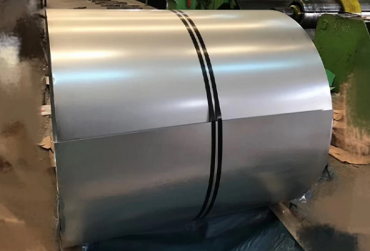
Curved gi sheet achieves stable support through the combination of structural design and mechanical principles,and is widely used in fields such as building roofs,automotive components,and mechanical casings.The support method needs to comprehensively consider material characteristics,bending technology,and practical application scenarios.The following analysis will be conducted from three aspects:support principles,structural types,and application scenarios.
1.Supporting principle:Material properties and mechanical equilibrium
(1)The core of the curved gi sheet support lies in utilizing the anti-corrosion properties of the zinc layer and the ductility of the substrate,and achieving stress dispersion through reasonable design.
(2)Material characteristics:Galvanized sheet substrate(such as cold-rolled steel sheet)has good ductility and can withstand bending without cracking;The zinc layer extends the service life by sacrificing the anode to protect the substrate.When bending,it is necessary to control the amount of deformation to avoid zinc layer detachment or substrate cracking.
(3)Mechanical equilibrium:Curved structures disperse pressure through curvature and radius of curvature.For example,arch bending can convert concentrated loads into uniformly distributed forces along the surface,enhancing overall stability.The design of support points should ensure a smooth transition between curved and flat sections to avoid stress concentration.
2.Supporting structure type:adaptable to different scenarios
(1)The support method for curved gi sheet varies depending on the application scenario,and common types include:
(2)Self supporting structure:Galvanized sheets with small curvature radius(such as C-shaped channel steel)are supported by their own stiffness and are commonly used for lightweight roofs or partitions.Its advantages lie in the absence of additional frameworks,low cost,and easy installation.
(3)Frame auxiliary support:Large span or complex curved structures(such as curved walls)require steel beams or aluminum alloy frames.The frame is fixed to the galvanized sheet by bolts or welding to ensure overall stability.For example,the curved roof of sports venues often uses a combination of galvanized sheets and trusses,balancing aesthetics and load-bearing capacity.
Point support:Precision equipment enclosures(such as electrical cabinets)use point support to fix curved gi sheets through positioning pins or buckles,ensuring structural strength and facilitating disassembly and maintenance.
3.Application scenarios and optimization directions
(1)In the field of architecture,when using curved gi sheets for roofs and curtain walls,drainage and wind resistance should be considered for support.For example,a curved roof needs to be designed with a drainage slope,and the spacing between support points should be calculated based on snow and wind loads to ensure safety in extreme weather conditions.
(2)Automotive industry:Body bending parts(such as door inner panels)are combined with high-strength steel frames through laser welding,and the support design needs to balance lightweight and collision safety.
(3)Future trend:With the development of 3D bending technology,galvanized sheet supports are evolving towards personalization and integration.For example,by parameterizing design to generate optimal curvature and combining it with intelligent sensors to monitor support status in real-time,the reliability of the structure can be improved.
Curved gi sheet,with its unique bending process and reliable support method,has demonstrated strong adaptability and stability in many fields.Whether it is the clever construction of building structures or the stable support of industrial equipment,curved gi sheet plays a key role in its excellent performance.It is not only a manifestation of material innovation,but also an important force driving the development of various industries.

 Language




 Address:Bo Xing County, Shandong Province
 E-mail: